
Everyone Told Me to Build My Personal Brand. Nobody Told Me to Do This First.
🎧Prefer to listen? Here’s me reading the article to you
You've probably looked at coaches you admire online, their carefully curated feeds, beautifully designed websites, thousands of engaged followers, fancy TV features and thought: I need all of that to make it as a coach.
Or maybe you typed "how to build a personal brand as a coach" into Google, got hit with a list of twelve things you need to do, closed the tab and opened a tub of ice cream instead.
No judgment because I've been there. More than once.
I spent years believing personal branding meant a polished website, a growing social following, and being featured on TV. It took me 11 years, 5 painful pivots, and more money spent in the wrong places than I will ever fully disclose to unlearn it.
Here's what I actually learned.
I started in August 2014, right after leaving a leadership role at a big NGO. I was “enjoying” my sabbatical while going through what I can only describe as an existential crisis. I didn't have clarity about what I wanted to do with my life. I only knew I wanted to write.
So I started a blog. One in-depth article every single weekday for six months straight. Five articles a week, for six freaking months. My younger self had energy I now regard with deep respect and major face palm.
Looking back, I was doing personal branding without knowing it. And because no one was guiding me, I did the right things in completely the wrong order.
I built a brand before I had a business. I had no idea who I was serving, what my message was, or how I'd make money from any of it. I just wrote whatever came to mind. It was like singing “Into the Unknown” directly into the void - except it didn’t look nearly as cool as in Frozen 2.

It was like singing “Into the Unknown” directly into the void - except it didn’t look nearly as cool as in Frozen 2.
Then I opened a yoga studio. And that's where it got complicated. My blog had built a global, English-speaking audience. My yoga studio was local, in Vietnam. The brand and the business didn't match.
So even though I kept writing consistently, none of that effort translated into studio clients. The people reading my blog weren't the people who could walk through my door. I ran that studio for two years, barely broke even and had to close it.
Then came coaching. And with it, more pivots than I'd like to count. I started as a relationship coach. Moved into self-love and confidence. Then purpose and career transition. Now business coaching for coaches.
Each pivot taught me something. And each one also cost me time, money, and energy I could have saved if I'd known what I'm about to share with you. Consider this my gift to you. And also my therapy.
Before we go anywhere, let me clear up what personal branding is not. Because I enthusiastically made every single one of these mistakes myself.
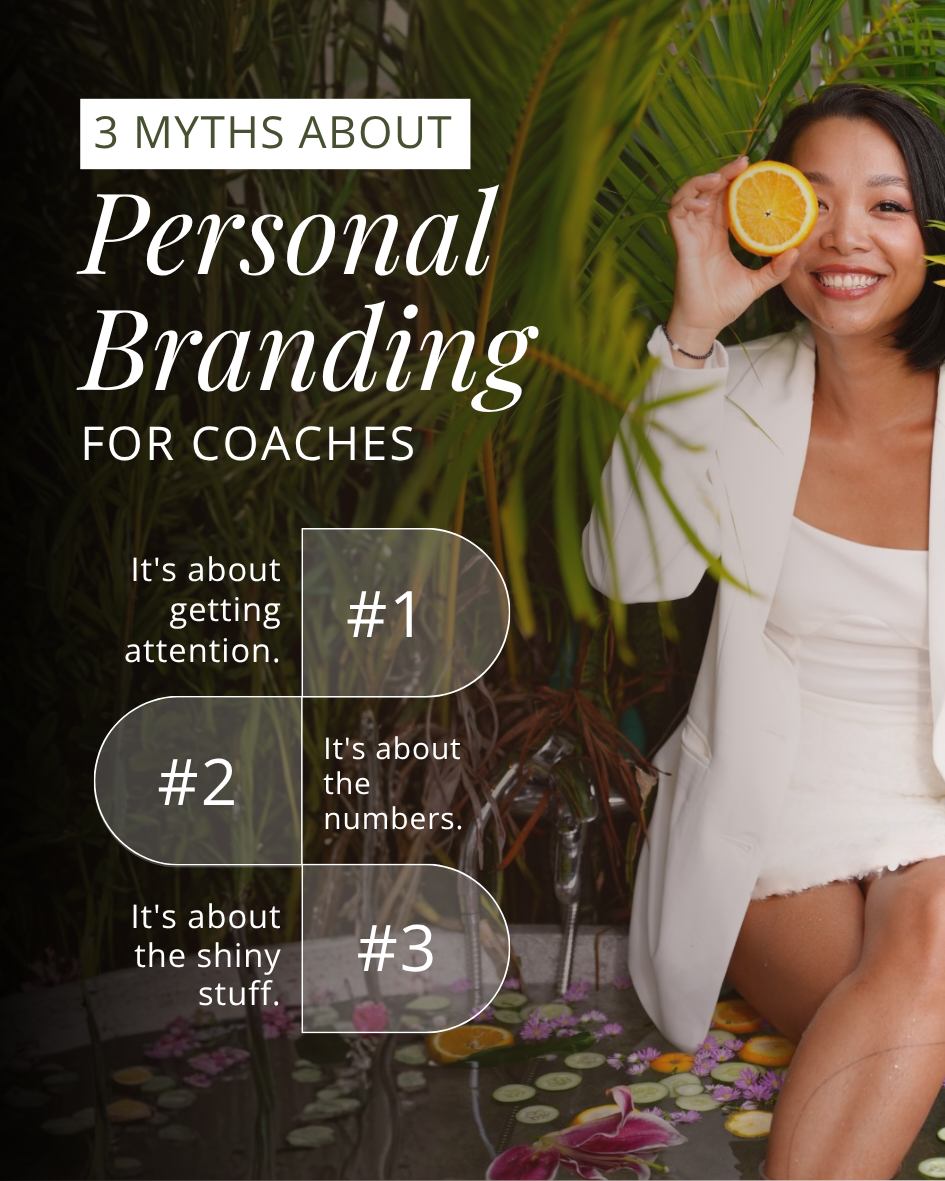
Myth 1
It's about getting attention.
Most people approach personal branding, and content creation, with one goal: to be seen. To get more followers, more reach, more eyes on their work. And so did I.
But along the way I figured out something different.
A powerful personal brand doesn't get attention. It gives attention.
When you know the person you're here to serve so deeply, so specifically, that every single thing you put out makes her stop mid-scroll and think: finally someone sees me.
That's not self-promotion. That's recognition and empathy. And it builds a quality of trust that no follower count ever will. Your ideal client doesn't need another coach talking about themselves. She needs to feel, finally, that someone sees her.

When you know the person you're here to serve so deeply, that every single thing you put out makes her stop mid-scroll and think: finally someone sees me.
Myth 2
It's about the numbers.
Followers, likes, reach. If you're building a brand in the personal development space, it's easy to think this is the whole game. It isn't.
What actually matters is the quality of the relationship you build with the people who find you, and how deeply you impact their lives. I used to track my follower count, my likes and comments obsessively. Coming back to a post to check every 12 minutes like that was going to change something. It never did.
Follower count is just a vanity metric. Email subscribers, quality relationships, enrolments of real paying clients, and people who've actually experienced your work: that's what matters. Social media should support your brand. It was never meant to be the whole strategy.
Myth 3
It's about the shiny stuff.
The polished website. The color-coordinated feed. The perfect bio photo. I once spent three weeks agonizing over a brand color palette. Three freaking weeks. The clients I have now have never once mentioned my brand colors.
Your brand is what people say about you when you're not in the room. The real brand-building work happens behind the scenes: getting clear on who you serve, building something that actually delivers on what you promise, and making sure every person who comes into contact with you walks away more uplifted than before.
You already have a personal brand, whether you've been intentional about it or not. People are forming opinions of you regardless. The only choice you get to make is whether you shape it on purpose.

You already have a personal brand, whether you've been intentional about it or not. The only choice you get to make is whether you shape it on purpose.
So if that's what personal branding isn't, what does it actually look like to build one that works?
After 11 years of getting it wrong, getting it right, and guiding hundreds of coaches through this, I've distilled it into a three-stage framework I call C.I.A.: Clarify, Ignite, Amplify.
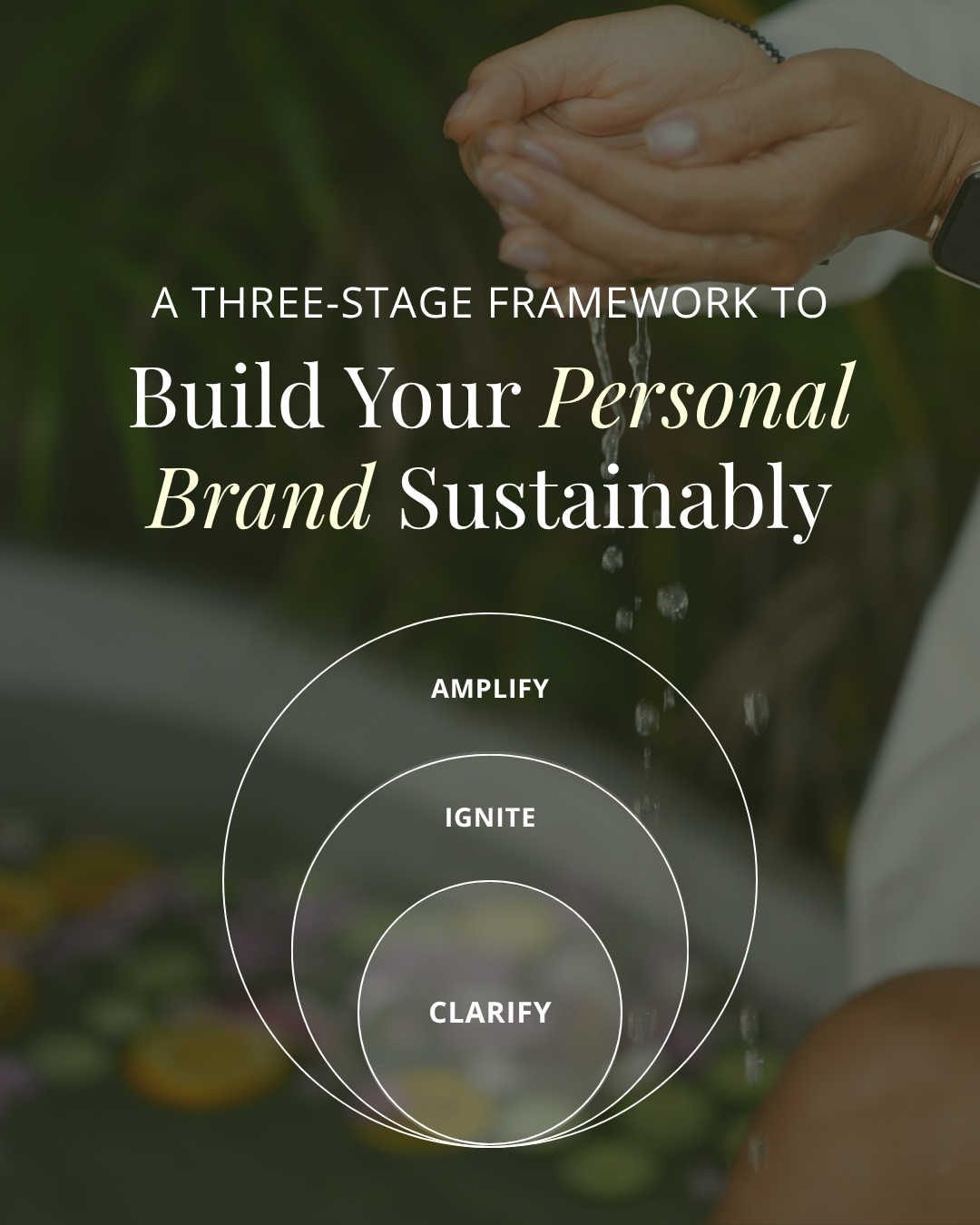
Clarify
is where everything begins. Before you actively build a brand, you need to get honest about four things: your why, your who, your what, and your how. Why do you want to do this? Who are you here to serve? What message do they need to hear from you? And how will you actually deliver on that? Get clear on all four before you build anything else.
And I say that from painful experience. I spent months, more than once, building a website based purely on assumptions, only to launch it and realize the message, the audience, even the offer itself was wrong. If you haven't worked with people yet, hold off on the website. Get clear first. Hire it out later. It will save you far more time than it costs.
Here's the truth I wish someone had told me earlier: it’s ineffective to build a brand without a business underneath it. And you can't build a real coaching business without your first real paying client. That client isn't just income. They're information. They tell you what's actually true about your message, your offer, and the people you're here to serve. Everything else is just a guess-work until then.
Ignite
is where you build your foundational assets: a website, content, a mailing list. Think of social platforms as a park where people gather, and your website as your shop.
You show up in the park to connect and share something useful, then invite people back to your shop, where the real depth lives.
Your mailing list is the most valuable asset you'll build. Once someone is on your list and actually looks forward to hearing from you, you can nurture that relationship for years.
Amplify
is where you go bigger: new channels and content formats, collaboration, PR features. This is the stage that looks glamorous from the outside. The stage everyone on Instagram seems to already be at. But it's the third stage, not the first.
Don't reverse-engineer someone else's output when you don't yet have what's behind it. That's like trying to bake a wedding cake before you've learned how to make toast.
Each of these stages deserves its own deep dive, and I might be writing about each one separately.
But for now, the most important thing is simply knowing which stage you're actually in, so you can stop doing stage three work when you're still in stage one.
The next time you find yourself scrolling past a coach you admire, the beautiful website, the thousands of followers, the shiny TV feature, I want you to know something.
Most of the coaches I've mentored started with almost no online presence. Many of them are introverted. Many of them barely posted on social media. And they built real, sustainable coaching businesses anyway.
Because a real business doesn't need a famous face to get started. It needs one thing: clarity on who you serve and what you help them with.
Get clear on that. Start offering. Your first real paying client will teach you more about your message than any branding exercise ever could. And when you're ready to amplify? You'll have something real to amplify.
The personal brand comes after. Right now, all you need is the courage to begin.
With love and all the attention you deserve to give,
Milena
Listen to the audio version

Join my Wildflower Letter
…filled strange business advice that has made me loads of happy money, behind-the-scenes confessions, laugh-out-loud stories, and hot updates I just don’t share anywhere else.
P.S. The hardest part of C.I.A. isn't Amplify. It's Clarify. Getting honest about your why, your who, and the message that's uniquely yours. Most coaches either skip it entirely or spend years overthinking it alone. Unlock Your Coaching Genius is the shortcut. It's a digital course designed to help you take full inventory of your experiences, get clear on the coaching specialty most aligned to your lived wisdom, and build from there. Clarity first. Everything else follows. Join the course.
P.P.S. Not ready for the course yet? You still need to start somewhere. Grab the Your First Paying Client Clarity Guide while it's still free. Because your first real paying client isn't just a milestone. They're the moment everything begins to click.

Hey, fellow purpose-driven human!
I'm Milena. At 24, I turned down corporate offers to do my own thing — and 9 years later, I'm making a multi-six-figure living as a coach, mostly barefoot in my apartment.
I know you want to make a difference. I'm here to help you turn that calling into a financially sustainable coaching business — without the hustle, without the pitfalls. Quit the 9-to-5. Work from sunlit cafes. Serve clients who light you up. Wake up excited.
All of it is possible, with the right support. Let me help you shine.


What 11 years and 5 painful pivots taught me